Skip to content
Saw Guide Lab
  • Circular Saw
  • Drywall Saw
  • About Me
Saw Guide Lab
  • What Is Detent Override on a Radial Arm Saw?
    Radial Arm Saw

    What Is Detent Override on a Radial Arm Saw?

    ByDaniel Carter — Saw & Cutting Tools Expert November 23, 2026

    A detent override on a radial arm saw is a mechanism that temporarily bypasses the saw’s preset miter-angle stops so you can position the radial arm at an angle between the standard indexed settings. Instead of the indexing pin automatically engaging at a common angle such as 0°, 22.5°, or 45°, the override keeps the…
    Read More What Is Detent Override on a Radial Arm Saw?Continue

  • What Is a Turret Style Radial Arm Saw? How It Works & Uses
    Radial Arm Saw

    What Is a Turret Style Radial Arm Saw? How It Works & Uses

    ByDaniel Carter — Saw & Cutting Tools Expert November 21, 2026

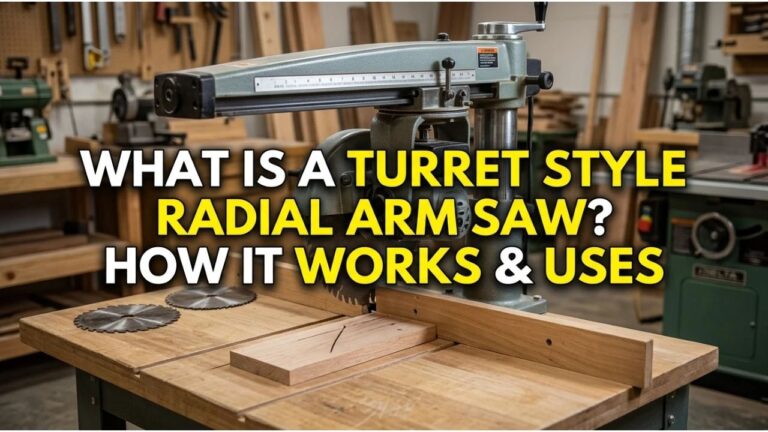
    If you are wondering what is a turret style radial arm saw, it is a radial arm saw whose horizontal saw arm pivots around a vertical column or turret so the entire arm can swing left or right for miter cuts. The motor and circular saw blade ride on a carriage that slides along that…

    Read More What Is a Turret Style Radial Arm Saw? How It Works & UsesContinue

  • Can a Radial Arm Saw Cut Steel?
    Radial Arm Saw

    Can a Radial Arm Saw Cut Steel?

    ByDaniel Carter — Saw & Cutting Tools Expert November 21, 2026

    If you are wondering can a radial arm saw cut steel, the answer is yes only when the saw is specifically designed and equipped for metal cutting. A standard woodworking radial arm saw should generally not be converted to cut steel simply by installing a metal-cutting or abrasive blade. Steel-cutting radial arm saws do exist,…

    Read More Can a Radial Arm Saw Cut Steel?Continue

  • Can a Radial Arm Saw Cut Composite Boards? Blade & Safety Guide
    Radial Arm Saw

    Can a Radial Arm Saw Cut Composite Boards? Blade & Safety Guide

    ByDaniel Carter — Saw & Cutting Tools Expert November 21, 2026

    Yes, a radial arm saw can cut many types of composite boards, including composite decking, MDF, particleboard, melamine-faced panels, and some engineered wood products, as long as you use the correct blade and setup. The important part is matching the blade to the material, supporting the work properly, controlling dust, and avoiding overly aggressive tooth…

    Read More Can a Radial Arm Saw Cut Composite Boards? Blade & Safety GuideContinue

  • Which Way Does a Radial Arm Saw Blade Spin? Rotation Explained
    Radial Arm Saw

    Which Way Does a Radial Arm Saw Blade Spin? Rotation Explained

    ByDaniel Carter — Saw & Cutting Tools Expert November 21, 2026

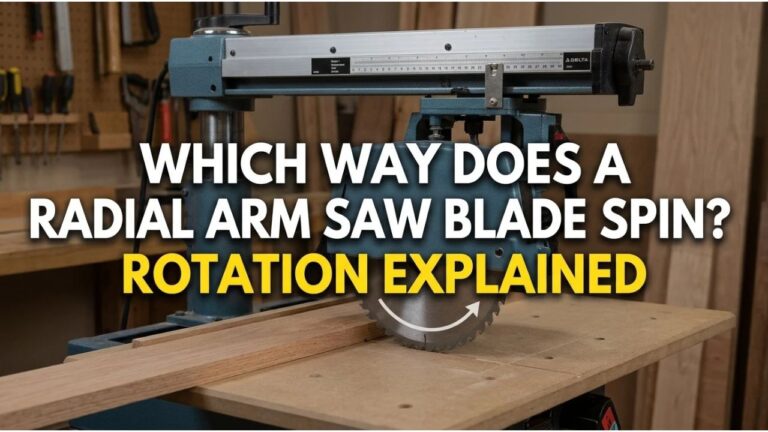
    If you are wondering which way does a radial arm saw blade spin, in the normal crosscut position the blade should rotate so the teeth at the front of the blade travel downward into the workpiece, while the teeth at the bottom move toward the fence, or rear of the saw. This rotation direction is…

    Read More Which Way Does a Radial Arm Saw Blade Spin? Rotation ExplainedContinue

  • What Size Blade Does a Radial Arm Saw Use? Complete Guide
    Radial Arm Saw

    What Size Blade Does a Radial Arm Saw Use? Complete Guide

    ByDaniel Carter — Saw & Cutting Tools Expert November 21, 2026

    What size blade does a radial arm saw use? Most vintage home-shop radial arm saws use a 10-inch blade, while larger contractor and industrial machines commonly use 12-, 14-, or 16-inch blades. Heavy industrial radial arm saws can use 20- or even 22.5-inch blades. Older compact machines may use 8-, 8¼-, or 9-inch blades. The…

    Read More What Size Blade Does a Radial Arm Saw Use? Complete GuideContinue

  • Should a Radial Arm Saw Blade Have a Negative Hook Angle?
    Radial Arm Saw

    Should a Radial Arm Saw Blade Have a Negative Hook Angle?

    ByDaniel Carter — Saw & Cutting Tools Expert November 20, 2026

    If you are wondering should a radial arm saw blade have a negative hook angle, the answer is generally yes for crosscutting: a neutral to slightly negative hook angle is usually preferred because it reduces the blade’s tendency to pull itself aggressively into the workpiece. A strongly positive-hook blade can make a radial arm saw…

    Read More Should a Radial Arm Saw Blade Have a Negative Hook Angle?Continue

  • How High Should a Radial Arm Saw Fence Be?
    Radial Arm Saw

    How High Should a Radial Arm Saw Fence Be?

    ByDaniel Carter — Saw & Cutting Tools Expert November 20, 2026

    A radial arm saw fence should be high enough to support the workpiece securely without interfering with the blade, guard, motor, or carriage. As a general rule, the fence should never be excessively short; several Craftsman radial arm saw manuals specify at least 3/4 inch of fence height and, depending on the model, require the…

    Read More How High Should a Radial Arm Saw Fence Be?Continue

  • How Wide Should a Radial Arm Saw Workbench Be?
    Radial Arm Saw

    How Wide Should a Radial Arm Saw Workbench Be?

    ByDaniel Carter — Saw & Cutting Tools Expert November 20, 2026

    A radial arm saw workbench should usually be deep enough to support the saw’s full table and fence while leaving clearance behind the column and enough support in front of the fence. For many 10-inch radial arm saw setups, a bench around 24 to 30 inches deep is a practical starting point, but the exact…

    Read More How Wide Should a Radial Arm Saw Workbench Be?Continue

  • How Deep Should a Radial Arm Saw Table Be? Size Guide
    Radial Arm Saw

    How Deep Should a Radial Arm Saw Table Be? Size Guide

    ByDaniel Carter — Saw & Cutting Tools Expert November 20, 2026

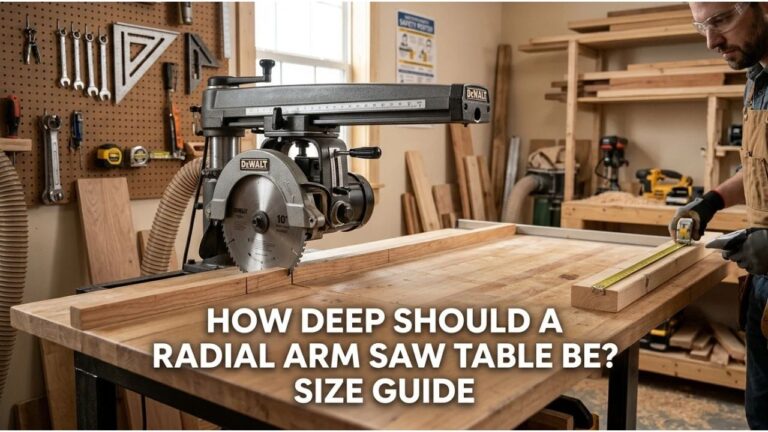
    If you are wondering how deep should a radial arm saw table be, the safest answer is to match the original table depth specified for your particular saw. On many classic 10-inch Craftsman radial arm saws, the main front table is roughly 18–19 inches deep, while additional fence, spacer, and rear-table sections bring the total…

    Read More How Deep Should a Radial Arm Saw Table Be? Size GuideContinue

  • How Much Space Does a Radial Arm Saw Need?
    Radial Arm Saw

    How Much Space Does a Radial Arm Saw Need?

    ByDaniel Carter — Saw & Cutting Tools Expert November 20, 2026

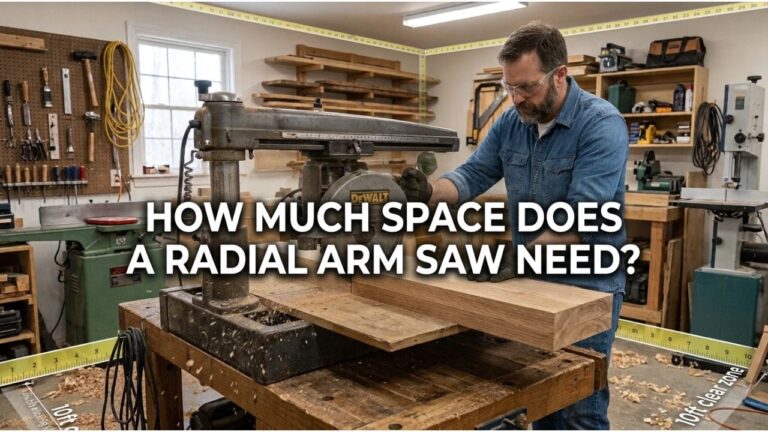
    If you are wondering how much space does a radial arm saw need, plan on roughly 3–4 feet of depth and at least 6–8 feet of usable width for the saw itself, with much more side clearance if you regularly cut long boards. A compact setup may fit against a wall in a 6 ×…

    Read More How Much Space Does a Radial Arm Saw Need?Continue

  • How Thick Can a Radial Arm Saw Cut? Depth by Blade Size
    Radial Arm Saw

    How Thick Can a Radial Arm Saw Cut? Depth by Blade Size

    ByDaniel Carter — Saw & Cutting Tools Expert November 19, 2026

    If you are wondering how thick can a radial arm saw cut, a typical 10-inch radial arm saw can often crosscut material around 3 inches thick at 90 degrees, while larger 12- and 14-inch machines can usually cut thicker stock. The exact capacity depends on blade diameter, arbor position, motor and guard clearance, table height,…

    Read More How Thick Can a Radial Arm Saw Cut? Depth by Blade SizeContinue

Page navigation

1 2 3 … 17 Next PageNext

© 2026 Saw Guide Lab

  • Circular Saw
  • Drywall Saw
  • About Me